
Quick Answer
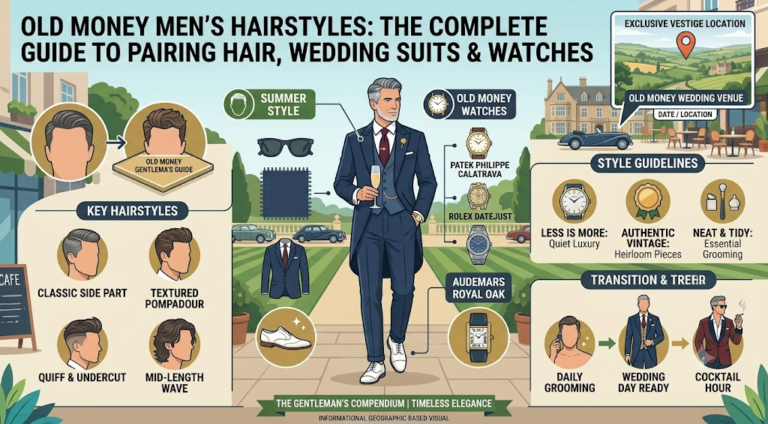
Old money men’s hairstyles favor clean, structured cuts — think side parts, classic crops, and low-maintenance textures — because they signal understated elegance rather than trend-chasing. For weddings, these cuts pair best with tailored suits in navy, charcoal, or grey, finished with a minimalist dress watch (leather strap, thin case, neutral dial). The combination works because all three elements share one principle: restraint over flash.
Key Facts Table
| Element | Old Money Standard | Why It Works |
|---|---|---|
| Haircut | Side part, classic crop, low taper | Neat, timeless, low upkeep |
| Suit color | Navy, charcoal, grey | Versatile, photographs well |
| Suit fit | Tailored, structured shoulder | Signals craftsmanship |
| Watch case | 36-40mm | Proportional, not flashy |
| Watch strap | Leather or metal bracelet | Classic over trendy |
| Grooming | Sharp neckline, minimal product shine | Polished, not overstyled |
Introduction
Old money style isn’t about spending the most — it’s about looking like you’ve never had to try. This aesthetic, rooted in mid-century tailoring and quiet luxury, has become one of the most searched men’s fashion trends of the decade. For Fashion Bazar’s audience planning weddings, formal events, or simply refining their everyday look, understanding how hairstyle, suiting, and watches work together as a single visual system is the difference between “dressed up” and “well put together.”
What Defines an Old Money Hairstyle?
Old money hairstyles trace back to Ivy League and European aristocratic grooming traditions of the 1950s-60s. The core traits are:
- Structured, not sculpted — hair holds shape without looking “done”
- Short-to-medium length with clean edges around the ears and neck
- Natural texture, minimal gel shine
- Classic partings — side part or slight quiff, rarely anything asymmetric or bleached
Popular Old Money Cuts
- Side Part — the most recognizable old money cut; works for boardrooms and weddings alike.
- Classic Crop — short on the sides, slightly longer on top, easy to maintain.
- Ivy League Cut — a longer crop with a soft fringe, named after 1950s collegiate style.
- Low Taper with Comb-Over — subtle fade paired with combed styling for a refined finish.
Pairing Hairstyles With Wedding Suits
A wedding is where old money style is put to its biggest test — every element is photographed and scrutinized. The rule of thumb: your haircut should frame your face without competing with your suit’s tailoring.
| Suit Style | Best-Matched Hairstyle | Notes |
|---|---|---|
| Navy three-piece | Side part | Classic groom look, works in most venues |
| Charcoal grey slim-fit | Classic crop | Modern but still restrained |
| Tweed or textured suit | Ivy League cut | Softer hair balances heavier fabric |
| Black-tie tuxedo | Low taper, slicked side part | Sharpest, most formal pairing |
Groomsmen and grooms alike benefit from cuts that survive a full day of events — ceremony, photos, reception — without needing a touch-up.
The Role of Men’s Watches in Old Money Style
A watch is often the single most noticed accessory in old money dressing, as it’s visible in nearly every handshake, toast, and photograph. Horology experts and heritage watchmakers generally agree that a dress watch should be understated: a thin case (36-40mm), a simple dial (no chronograph clutter), and a leather or steel bracelet strap.
Actionable tip: Match your watch metal to your suit hardware — silver-toned watches with grey/charcoal suits, gold-toned with navy or brown tones.
Step-by-Step: Building the Old Money Look for a Wedding
- Book a haircut 5-7 days before the event (fresh cuts often look too sharp on camera).
- Choose a tailored suit in navy or charcoal as your base.
- Select a minimalist watch under 40mm.
- Keep grooming products matte — avoid heavy shine.
- Finish with leather shoes and a matching belt.
Key Takeaways
- Old money hairstyles are defined by structure, neatness, and restraint.
- Side parts and classic crops pair most reliably with wedding suits.
- Watches complete the look — simplicity beats complexity.
- The whole outfit should read as intentional, not trend-driven.
FAQ Section
1. What is the “old money” hairstyle trend? It’s a return to classic, structured cuts like side parts and crops, inspired by mid-century aristocratic grooming rather than modern trend-driven styles.
2. Which haircut is best for a wedding? A side part or classic crop generally photographs best and pairs with most suit styles.
3. Do old money hairstyles require daily styling? Most require light product and a comb — they’re designed to be low-maintenance.
4. What suit colors suit old money style? Navy, charcoal, and grey are the most versatile and widely recommended by tailors.
5. What size watch fits old money style? 36-40mm cases are considered the classic, proportional range.
6. Should groomsmen match hairstyles? They don’t need identical cuts, but similar neatness and length create a cohesive wedding party look.
7. Is a beard part of old money style? Yes, when neatly trimmed — a groomed beard or clean shave both fit; unkempt facial hair does not.
8. How often should I get a haircut for this style? Every 3-4 weeks maintains the sharp, structured edges the look depends on.
9. Can old money style work for casual outfits? Yes — the same haircuts pair well with chinos and knitwear, not just suits.
10. Where can I shop old money-inspired wedding suits? Explore curated collections at Fashion Bazar for tailored suiting suited to this aesthetic.
Conclusion
Old money style succeeds because every element — hair, suit, watch — is chosen to look effortless, not expensive. For weddings especially, this restraint photographs better and ages better than trend-driven alternatives. Start with a clean, structured haircut, build around a well-tailored navy or charcoal suit, and finish with a simple, proportional watch. For more curated wedding suiting and accessories, visit Fashion Bazar at latestdresstrends.com or reach out at info@hairsources.com.